CHOICE OF EXTINGUISHING AGENT
Fire Classes
The choice of extinguishing agent is primarily determined by the predominant fire class in the zone served by the extinguisher. Where multiple fire classes occur together, the type of extinguisher should be chosen such that all fire classes are covered.
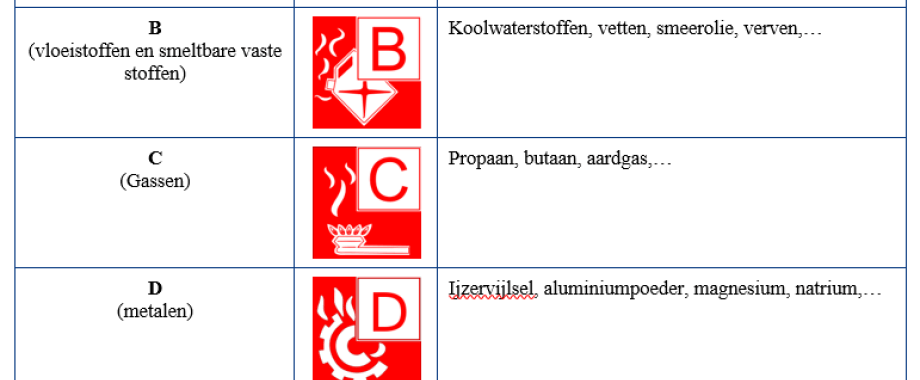
The different fire classes are shown in the table, together with their symbol.
Types of extinguishing agents
Water
Water is the most commonly used extinguishing agent and is suitable for extinguishing class A fires. To improve its extinguishing power, additives can be added, of which a foaming agent is the most commonly used.
Water / foam
A water / foam extinguisher is suitable for extinguishing class A fires, but because the foam spreads over the surface and thus smothers the fire, it can also be used for extinguishing class B fires.
Extinguishing powder
Powder extinguishers are available with different types of extinguishing powder. The most common are BC extinguishing powder and ABC extinguishing powder, suitable for BC and ABC fires respectively. Important advantages of powder extinguishers are their high extinguishing capacity, wide applicability and relatively low cost. A significant disadvantage is the extensive collateral damage caused by the dispersion of the very fine extinguishing powder, especially to electronic equipment. They are therefore gradually being superseded by foam extinguishers.
Extinguishers for metal fires are also mainly of the powder extinguisher type, but with a special type of extinguishing powder.
Carbon dioxide or CO2
Carbon dioxide is suitable for extinguishing class B and C fires. However, its extinguishing power is much more limited (approximately 1/6th) than that of extinguishing powders. The extinguishers are immediately recognizable by the black expansion horn at the end of the extinguishing hose. The extinguishers are equipped with a handle between the expansion horn and the hose, which must be held during extinguishing to protect against the very cold temperatures during extinguishing (up to -80°C).
Wet chemicals
This is a type of extinguishing agent (chemical extinguishing foam) that is better suited for extinguishing class F fires than water/foam, CO2 and extinguishing powder. This foam combines with the frying fat, covers it better and provides a strong cooling effect.
Extinguishing gases
Extinguishing gas installations are particularly suitable for use in spaces with sensitive or valuable electrical or electronic equipment. Their operation is often based on displacing oxygen in the room to control the fire. Typical for these installations is the prohibition of access to the rooms when the extinguishing installation is activated.
DETERMINATION OF THE NUMBER OF EXTINGUISHERS
The protection of a building or installation with extinguishers consists of a general zone protection and additional protection for specific activities and objects.
The determination of the number of extinguishers is done on a zone-by-zone basis. After determining this zone protection, it is necessary to check which additional extinguishers are needed in specific places.
General zone protection
The number of extinguishers depends on the floor area of the zone (m²), the nature of the fire hazard, the extinguishing capacity of the devices, and the maximum walking distance to the nearest extinguisher.
Zone classification
Floor by floor, the building is divided into basic zones, for which it applies that:
- the same type of activity takes place AND
- there is the same predominant fire class AND
- all parts of the zone are adjacent
Nature of the fire hazard
For each zone, the predominant fire class is determined:
- Predominant fire class A
- Predominant fire class B
- Fire classes A and B both significantly present
- Predominant fire class D
Nature of the fire risk
The nature of the fire risk is also determined by the activities, in which we distinguish:
- activities with low fire hazard (type L)
- activities with moderate fire hazard (type M)
- activities with high fire hazard (type H)
Examples of the different activity types are:
- Type L: industry of non-combustible materials such as stone, concrete, glass and steel, in wet processes, in office buildings (excluding archives), in computer rooms…
- Type M: food industry with dry processes (bakeries,…), assembly of vehicles and household appliances, clothing industry, commercial kitchens, in residential buildings, in spaces accessible to the public, in archives and libraries, in most retail businesses,…
- Type H: woodworking industry, textile industry, plastics processing, paper processing, printing offices, waste processing, in theatres, discotheques, cinema halls,…
Method of basic units
The number of required extinguishing agents is determined for each zone using the method of extinguishing units:
For a predominant fire class A, this means:
- 1 extinguishing unit per 150m² (activities with low and moderate fire hazard)
- 1 extinguishing unit per 100m² (activities with high fire hazard)
NOTE: if no other extinguishing agents are present (hoses, sprinklers,…), this number of extinguishing units must be doubled!
For a predominant fire class B, one provides:
- 1 extinguishing unit per 100m²
For a predominant fire class D, the number and type of extinguishers are determined in consultation with the supplier of the extinguishers. However, the choice is submitted to the competent authority (fire department, fire insurer).
The use of CO2 extinguishers is not recommended for general building protection, but is rather recommended for object protection.
What is 1 extinguishing unit?
This is partly dependent on the type of extinguishing agent, but generally it can be stated that this corresponds to an extinguisher of 6kg ABC powder or 6 liters water/foam.
In a zone with a predominant fire class A, the devices must be placed such that the distance to the nearest device is not greater than:
- 20m measured along the walking line of the passages
- or 15m measured point to point in the space
In a zone with a predominant fire class B, the devices must be placed such that the distance to the nearest device is not greater than:
- 15m measured along the walking line of the passages
- or 10m measured point to point in the space
Provided that these maximum distances are observed, the extinguishers may however be grouped
Walking distance
When placing the extinguishers, a number of rules must be observed.
In a zone with a predominant fire class A, the devices must be placed such that the distance to the nearest device is not greater than:
- 20m measured along the walking line of the passages
- or 15m measured point to point in the space
In a zone with a predominant fire class B, the devices must be placed such that the distance to the nearest device is not greater than:
- 15m measured along the walking line of the passages
- or 10m measured point to point in the space
Provided that these maximum distances are observed, the extinguishers may however be grouped.
Additional protection
In a building, certain objects with specific fire risks require special attention. Examples include technical installations, welding installations, zones with flammable liquids or gases,…
Objects such as heating installations, computer systems, electrical power supplies, transformers and capacitors, compressors, electrogenerators have a specific fire risk and require at least one additional (suitable) extinguisher in the vicinity, unless:
- the chosen extinguishing agent for general zone protection is already suitable for this specific risk
- AND the extinguisher is located less than 5m from the object
Many other types of zones and activities also require additional extinguishers. However, these are the subject of a more in-depth investigation to determine the number and type of extinguishers and are not discussed in detail here.
These include:
- Storage areas for flammable liquids and gases in buildings / outside buildings
- High-stacking zones
- Work zones for flammable paints
- Outdoor storage of flammable products (pallets, cardboard, plastic, waste…)
- Temporary work with open flame
- Cold storage and freezing installations
- …
A common specific situation is kitchens where deep fryers are present. Here, additional extinguishers for fire class F must be provided.
PLACEMENT OF EXTINGUISHERS
As a general rule, extinguishers must be clearly visible to the persons who need to use them. The most suitable places are exits, passages to (emergency) exits, stairwells,…
Extinguishers must not be placed next to risks that could hinder their use.
Extinguishers may be placed in cabinets provided they either have a transparent door or are equipped with the pictogram for extinguishers in accordance with legislation.
Portable extinguishers must be attached to their supports or holders. Mobile extinguishers are located in a demarcated and designated place for them. The locations of the extinguishers are indicated with pictograms in accordance with legislation.
MAINTENANCE AND PERIODIC MAINTENANCE
The supplier of the extinguishers will provide the building operator – or their representative – with the necessary documents for the correct use of the devices.
The operator or their representative appoints a person responsible for the maintenance of the extinguishers. They also appoint a competent company to carry out the periodic maintenance (annual) of the extinguishers in accordance with standard NBN S21-050.