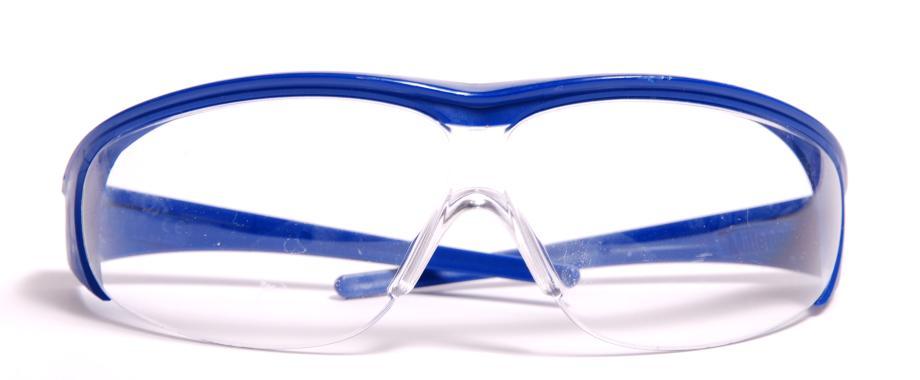
Question: is an employer obligated to provide (and thus pay for) safety glasses with corrective lenses?
Answer: eye protection is mandatory if indicated by the risk assessment. A PPE itself should not pose an increased risk. Royal Decree PPE Art. 6.- "Every PPE must in any case: 1° be suitable for the risks to be prevented, without itself posing an increased risk". Wearing a splash goggle over one's own corrective lenses can indeed entail an increased risk. Moreover, according to °3, the PPE must: "be adapted to the requirements regarding ergonomics, comfort, and the health of the employee". Art. 7 states "the PPE shall be provided by the employer free of charge to the employees". Furthermore, article 9 states: "...In this assessment, the employer shall, where applicable, take into account persons with a disability or a physical defect, so that, for example, the need to wear corrective lenses or orthopedic shoes is taken into account."
Conclusion: Premed's advice is that the employer, where applicable, must indeed provide and pay for safety glasses with corrective lenses.
Royal Decree PPE
Art. 6.- Every PPE must in any case:
1° be suitable for the risks to be prevented, without itself posing an increased risk;
2° comply with the prevailing circumstances at the workplace;
3° be adapted to the requirements regarding ergonomics, comfort, and the health of the employee;
4° after the necessary adjustment, be suitable for the wearer.
If the presence of multiple risks makes it necessary to wear several PPE simultaneously, these must be coordinated and remain effective for the risks concerned.
Art. 7.- Without prejudice to the application of article 16, second paragraph of the royal decree concerning the well-being policy, the PPE shall be provided by the employer free of charge to the employees.
Art. 9.- § 1.Before choosing a PPE, the employer shall make an assessment of the PPE he intends to use to verify to what extent it complies with the conditions set out in articles 5 and 6.
In this assessment, the employer shall, where applicable, take into account persons with a disability or a physical defect, so that, for example, the need to wear corrective lenses or orthopedic shoes is taken into account.
This assessment includes:
1° an analysis and evaluation of risks that cannot be prevented by other means;
2° the description of the characteristics that the PPE must possess to be able to address the risks mentioned under 1°, taking into account any sources of risk that the PPE itself may constitute;
3° the evaluation of the characteristics of the available PPE, in comparison with the characteristics mentioned in 2°.
The assessment referred to in this paragraph shall be reviewed whenever a change occurs in one of the components of this assessment.
- § 2.For drawing up the assessment referred to in § 1, the employer shall request the advice of the prevention adviser expert in occupational safety, as well as that of the prevention adviser-occupational physician responsible for the health surveillance of employees.
- § 3.The reports and the elements on which this assessment is based shall be kept available for the officials responsible for supervision.
- Protection against radioactive radiation:
13.2. A protective headgear or a face shield of suitable type, as the case may be, if they are exposed to exhalations of radioactive substances, gases, vapors or smoke or to splashes of liquids or other substances containing radioactive components.
13.6. Protective glasses or a face shield of suitable type if they perform operations that expose the eyes to the effects of radiation and insofar as in such a case the use of these protective means is actually useful (e.g., generation of beta radiation or very weak radiation).
ANNEX II
List of activities and working conditions for which the provision of PPE is necessary
- Protective glasses or face shield of suitable type:
a) workers whose eyes are exposed to contact with substances that have a pronounced irritating effect on the eyes, such as coal tar pitch dust and other dust particles or vapors of corrosive substances;
b) workers engaged in welding or cutting metals with a torch or electric arc;
c) workers engaged in examining intense light sources, such as the inside of furnaces, or substances brought to white heat, such as steel and molten glass;
d) workers engaged in operations using infrared rays or radiations that cause intense heat dispersion;
e) workers engaged in operations using electric arc lamps or other sources of ultraviolet rays;
f) workers engaged in dry grinding, chipping with splintering, scaling, cleaning with a hammer or other operations that may lead to the expulsion of damaging particles, molten metal, corrosive liquids, etc., that can affect the eyes;
g) workers who may be exposed to carcinogenic and mutagenic agents:
− during activities where exposure cannot be avoided by preventive measures, as provided for in articles 5, 6, 8 and 9 of the royal decree of 2 December 1993 concerning the protection of workers against the risks of exposure to carcinogenic and mutagenic agents at work;
− during activities, such as maintenance work, demolition work, renovation work, alteration work, for which exposure to these agents can be foreseen, notwithstanding the organisational measures taken or the collective prevention measures;